GPU-Accelerated Detector Error Model Sampling for Fault-Tolerant Modular Quantum Architectures with NVIDIA CUDA-Q

Abstract
Welinq is advancing distributed quantum computing by adapting error correction to support logical operations across interconnected quantum processors. Reliable quantum computation across interconnected processors requires understanding the way in which errors affect operations, both within and between them. Evaluating this reliability involves extensive simulations, rendering computational speed a key factor in exploring different architectures.
Building on our circuit-level study of fault-tolerant logical gates across noisy interfaces, we capture the effects of faults in a detector error model (DEM), which describes how the latter trigger error-detection signals and alter logical measurement outcomes. We then use NVIDIA CUDA-Q, the open platform for hybrid quantum-classical supercomputing, to accelerate sampling from this model with accelerated computing, reducing the computational cost of generating error scenarios and enabling more extensive statistical evaluations of architectural performance. Combined with decoding, these results constitute an important step for establishing the network requirements and error-correction overhead for reliable distributed quantum computation.
Introduction
Distributed quantum computing stands out as a critical enabler of large-scale computation and practical quantum advantage by interconnecting multiple quantum processing units (QPUs) through shared entanglement, enabling them to execute quantum algorithms collectively as a larger quantum computer. This modular approach addresses the resource and scaling constraints of monolithic architectures, including heterogeneous and complementary platform modalities. Its potential, however, depends on protecting the processed quantum information and on the reliable implementation of logical operations across processor boundaries.
Developing fault-tolerant distributed architectures therefore requires benchmarking how internal (intra-QPU) and interface (inter-QPU) noise jointly affect encoded operations. The choice of error-correcting code family, the allocation of logical qubits across QPUs and the protocols used for nonlocal operations determine both logical implementation and resource overhead. Studying these relationships identifies the network requirements and error-correction overhead needed for fault-tolerant computation across interconnected quantum processors.
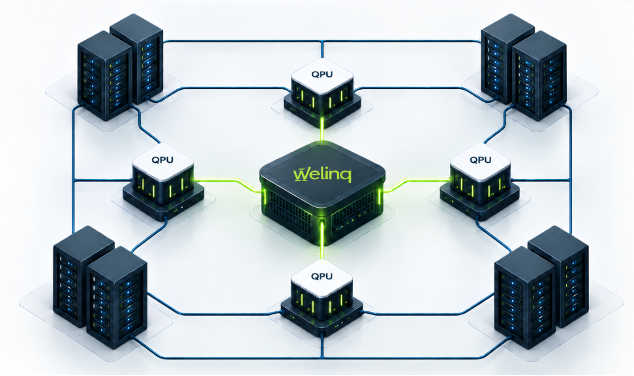
Welinq is building the infrastructure required to achieve practical distributed quantum computing and integration in quantum-augmented data centers. Along with the development of the modular compiler software araQne, mapping quantum algorithms across quantum networks of interconnected QPUs (Figure 1), Welinq is also developing orchestration tools, with the goal of bringing compilation, orchestration, and error correction together to support reliable distributed execution. Toward this goal, we assess how effectively error correction protects logical operations across interconnected quantum processors.
Here, we focus on a core step in this evaluation: sampling detector error models (DEMs). Derived from a physical circuit and its noise model, a DEM describes how faults trigger error-detection signals and flip the logical measurement outcomes used to assess whether the encoded operation succeeds. Sampling a DEM generates random realizations of these effects, which are then decoded to estimate how often error correction fails at the logical level. Accelerating this sampling enables larger statistical studies and more precise estimates of logical failure rates across modular architectures within practical computational budgets.
Logical Operations in Fault-Tolerant Modular Architectures
In our recent work1, we use circuit-level simulations and decoding to quantify how inter-QPU noise affects the fault tolerance of logical CNOT operations in modular quantum architectures. By encoding logical information in rotated surface-code patches, we study distributed logical CNOTs implemented through lattice surgery, with inter-QPU physical operations supported by shared noisy Bell pairs. We evaluate logical failure probabilities under depolarizing noise, assigning enhanced error probabilities to inter-QPU gates. The analysis shows that the studied implementations retain fault-tolerant behavior despite substantially noisier interfaces, with a modest threshold reduction relative to monolithic implementations. We further develop resource-efficient protocols for distributed logical GHZ state preparation. These studies provide building blocks and architectural guidance for future fault-tolerant implementations of distributed algorithms.
We start with engineering a distributed configuration for the CNOT in which logical qubits are encoded in rotated surface-code patches, with control, ancilla and target patches allocated across different QPUs (in the most general case). Logical CNOT gates are implemented using the method of lattice surgery, with inter-QPU physical operations relying on Bell-pair-assisted gate teleportation. The noise model we used represents these nonlocal physical gates by ideal operations followed by an effective two-qubit depolarizing channel, incorporating Bell-pair imperfections and the additional noise associated with the gate-teleportation protocol, used in this framework for the implementation of the cross-interface stabilizers and consequently for nonlocal syndrome extraction.
Circuit-level simulations are performed using LOOM2 and Stim3, with decoding carried out using PyMatching4. Local two-qubit gates have physical error probability \(p_{\text{bulk}}\), while nonlocal gates have probability \(p_i = \alpha\, p_{\text{bulk}}\), where \(\alpha\), referred to as the interface noise parameter, captures the additional noise associated with Bell-pair generation and gate teleportation. Logical failure probabilities are evaluated for several code distances and compared with corresponding monolithic implementations. In the latter, all two-qubit gates are assumed to have the same error rate, obtained with \(\alpha = 1\). In the distributed implementation instead, two-qubit gates acting on qubits located in different QPUs are assigned a higher error rate, associated with \(\alpha = 20\), in order to account for the additional noise introduced by gate teleportation and Bell-pair noise.
The results exhibit a modest reduction in the estimated threshold despite the enhanced nonlocal noise. In fact, inter-QPU operations can tolerate noise levels up to an order of magnitude larger than those within individual QPUs, with only a minor reduction in the fault-tolerance threshold relative to the monolithic case. This demonstrates a remarkable resilience to interface noise within the configurations and noise model studied.
DEM Sampling in a Nutshell
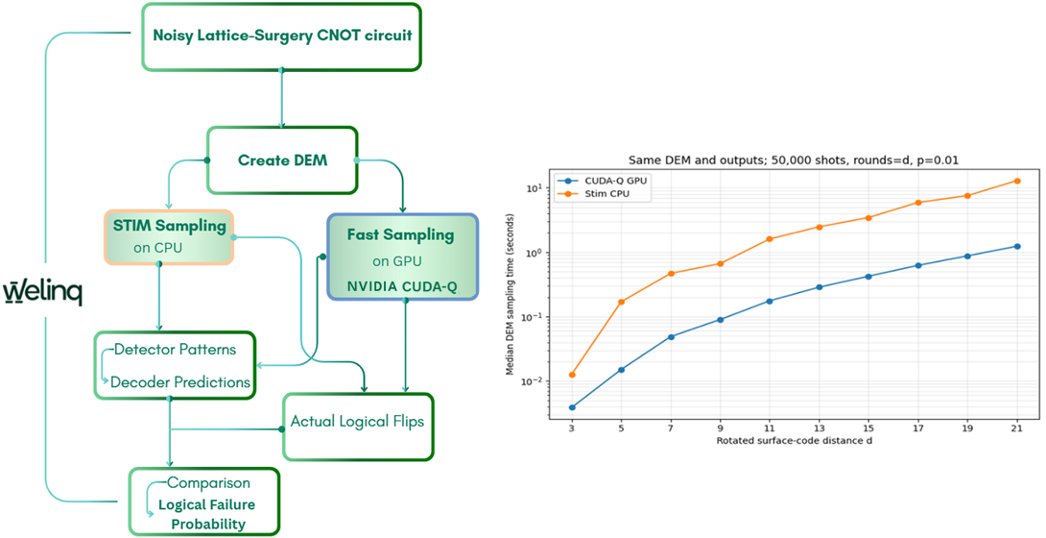
The way faults in a quantum error-correction circuit affect the information we use to identify errors is described by the detector error model (DEM)5, which is extracted from the physical circuit and its noise model. Each error mechanism has an occurrence probability and specifies which detectors (parities of selected measurement outcomes whose values are predictable in the absence of faults) and which logical observables it flips. For each simulated run, we independently sample error mechanisms according to their probabilities and combine their effects by XOR. In case two selected errors flip the same detector or logical observable, those flips cancel. Collectively, this process produces a detector pattern, along with the actual logical-observable flips induced by the sampled errors.
The detector pattern is used as a decoder input to predict the logical-observable flips. Comparing its prediction with the actual sampled flips tells us whether correction succeeds for the tracked logical observables; a disagreement for any tracked observable is counted as a logical failure. Repeating this procedure estimates the logical failure probability.
In our work, the underlying circuit implements a logical CNOT through nonlocal lattice surgery. The DEM describes how physical faults during the lattice-surgery CNOT, both in bulk and along the interface, affect the measured error signals and the logical observables used to assess the operation. Repeating the experiment across code distances and physical noise strengths produces the data for threshold plots.
GPU Acceleration via NVIDIA CUDA-Q
In this context, fast DEM sampling is essential for obtaining reliable logical-failure estimates within practical computational budgets. As code distance increases, logical failures below threshold become rarer, requiring more samples to estimate their probabilities accurately. Larger codes and additional interfaces can also increase the number of detectors and error mechanisms, raising the computational cost of sampling. These demands grow further when comparing many code distances, noise strengths, and interface configurations. Faster sampling therefore supports both precise statistics and faster research iteration in modular architectures.
In the present study, we benchmark DEM sampling for circuits implementing fault-tolerant nonlocal logical CNOTs via lattice surgery, following a rotated surface-code patch encoding. Using the same circuit-derived DEMs and shot counts (50k shots for \( d_{\max} = 21 \)), we compare Stim’s CPU sampler with sampling using NVIDIA CUDA-Q on an NVIDIA L4 Tensor Core GPU. For the considered configurations, we observe an approximately 10-fold reduction in sampling runtime in the case of the GPU sampling with respect to the CPU one, enabling faster generation of the statistical data needed for evaluation (Figure 2). In the framework of distributed architectures, accelerated DEM sampling can shorten the evaluation cycle, helping identify which network configurations support reliable logical operations and at what error-correction cost. Building on our recent work, it renders larger statistical studies more affordable, especially for configurations with multiple interfaces and multi-target logical controlled operations.
Regarding patch allocation, the advantage of fast sampling enables broader comparisons of how control, ancilla and target patches are assigned to QPUs, and how these choices affect both interface use and logical reliability. Towards our longer-term goal of heterogeneous quantum networks, the same approach can explore unequal interface quality and platform-dependent QPU noise, provided these characteristics are represented by compatible circuit noise models. The expected benefit is more extensive architectural comparisons within a given computational budget, while the overall runtime improvement also depends on decoding and the other simulation stages.
Outlook
DEM sampling is a core step in the workflow of estimating the reliability of quantum operations across noisy interfaces in modular quantum architectures. In this study, we have benchmarked DEM sampling for nonlocal logical CNOTs implemented through lattice surgery. Using identical models and sample counts, we compared Stim’s CPU sampler with NVIDIA CUDA-Q on GPU and observed a 10-fold reduction in sampling runtime in the latter for the tested configurations. By making larger statistics more affordable, this acceleration supports systematic exploration of how network connectivity, interface quality and error-correction resources jointly determine logical reliability. These insights inform the design of quantum data centers where interconnected processors operate as a unified, scalable, fault-tolerant computing system.
References
1 S. Chelluri et al., “Fault-Tolerant Logical Operations and Efficient State Preparation in Modular Quantum Architectures with Noisy Interfaces”, arXiv:2607.27204 (2026).
2 Entropica Labs, EL Loom (2026).
3 C. Gidney, “Stim: a fast stabilizer circuit simulator”, Quantum 5, 497 (2021).
4 O. Higgott, arXiv:2105.13082.
5 Stim, Detector Error Model File Format, GitHub.
Related articles

Welinq and Sparrow Quantum Partner to Bring Photonic Qubits into Multi-Platform Quantum Clusters
Welinq's araQne meets NVIDIA CUDA-Q: Distributed Quantum Compiling with GPU accelerated verification
Welinq and OVHCloud Partner on Networked Quantum Computing Architectures